
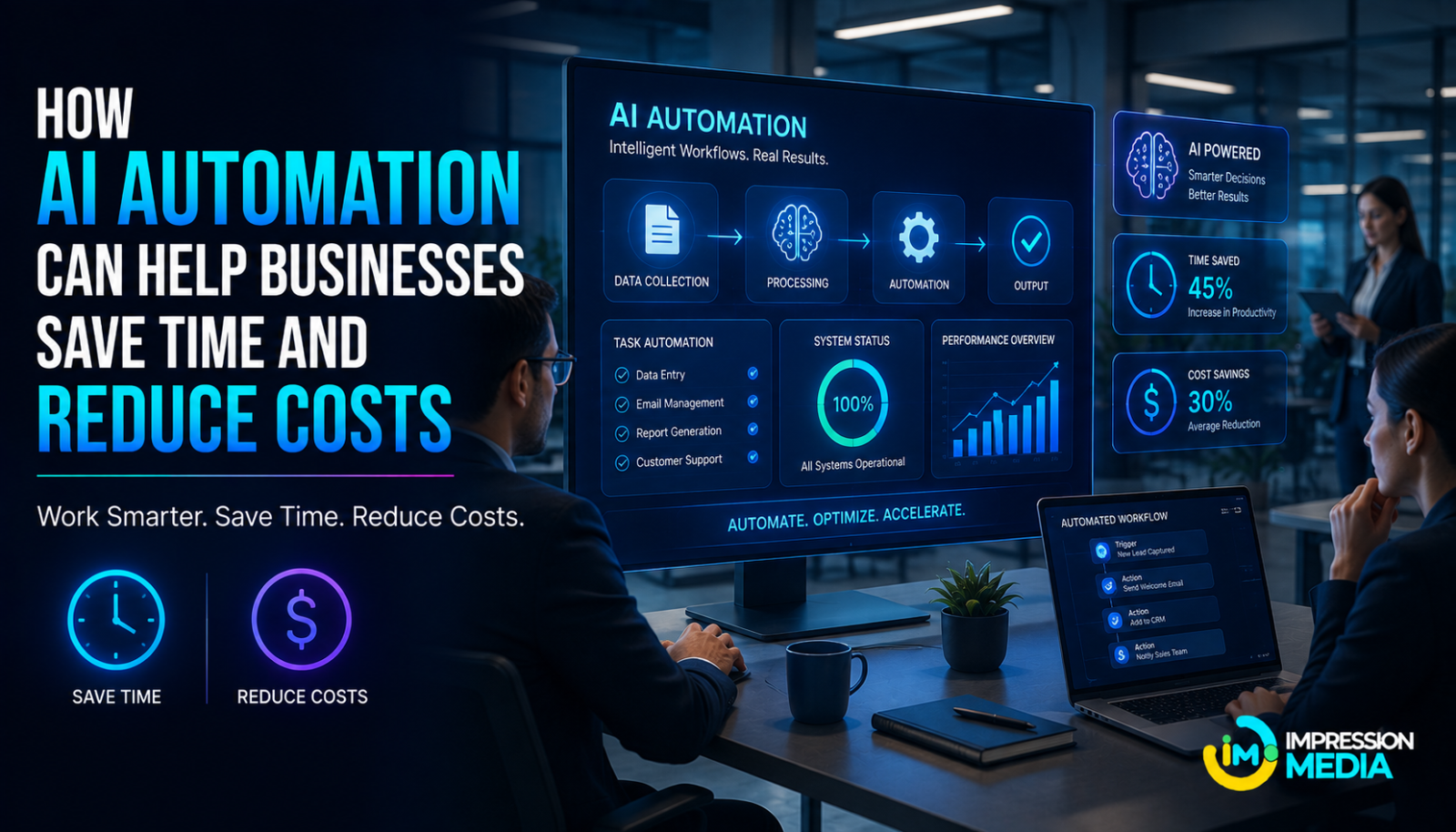
How AI Automation Can Help Businesses Save Time and Reduce Costs
Businesses constantly look for ways to save time and control costs. At the same time, customers expect faster and better service.
This is where AI automation can help.
Artificial intelligence can handle many repetitive business tasks. It can also analyse data, support customers, and improve daily workflows.
AI automation does not replace every human task. Instead, it helps employees spend more time on important work.
In 2026, businesses across industries are using AI to improve productivity. They are also using it to reduce operational costs and improve customer experiences.
Let’s explore how AI automation can help your business.
What Is AI Automation?
AI automation combines artificial intelligence with automated workflows.
Traditional automation follows fixed rules. AI automation can understand patterns and make decisions based on data.
For example, a traditional system may send the same email to every customer.
An AI-powered system can analyse customer behaviour. It can then personalise the message for each customer.
AI automation can support tasks such as:
- Customer support
- Data analysis
- Email management
- Lead qualification
- Content creation
- Appointment scheduling
- Document processing
- Sales follow-ups
- Workflow management
This makes AI automation useful for businesses of different sizes.
Why Do Businesses Need AI Automation?
Employees spend many hours handling repetitive tasks.
These tasks may seem small individually. However, they can consume significant time every week.
AI automation handles many of these activities automatically.
This allows employees to focus on strategy, creativity, problem-solving, and customer relationships.
AI can also reduce manual errors. Automated systems follow predefined processes consistently.
As a result, businesses can improve efficiency without constantly increasing their workforce.
How AI Automation Helps Businesses Save Time
1. Automate Repetitive Tasks
Repetitive tasks can take hours from your team's schedule.
AI can automate many routine activities. These include data entry, email sorting, reporting, and document processing.
Employees can then focus on higher-value responsibilities.
This can significantly improve workplace productivity.
2. Speed Up Customer Support
Customers want quick answers to their questions.
AI-powered chatbots can provide instant responses. They can handle common questions at any time.
For example, customers may ask about:
- Product availability
- Pricing
- Order status
- Business hours
- Service details
- Appointment availability
AI can answer these questions without human intervention.
Complex issues can then move to human support teams.
3. Improve Lead Management
Sales teams often receive leads from multiple channels.
Managing every lead manually can take considerable time.
AI automation can collect and organise lead information. It can also identify promising leads based on predefined criteria.
The system can then send leads to the right sales representative.
This helps sales teams spend more time talking to potential customers.
4. Automate Follow-Ups
Following up with prospects is important for sales.
However, teams can easily forget follow-up tasks.
AI automation can schedule and manage follow-up messages.
It can send emails or notifications at the right time.
This keeps prospects engaged without requiring constant manual work.
5. Automate Business Reporting
Businesses generate large amounts of data every day.
Employees often spend hours preparing reports manually.
AI tools can collect data from different sources. They can analyse the information and generate useful reports.
Managers can then spend more time making decisions.
How AI Automation Helps Reduce Business Costs
Saving time can also reduce operational expenses.
However, AI automation can provide several other cost-saving benefits.
1. Reduce Manual Work
Businesses often spend money on repetitive administrative work.
AI automation can handle many routine processes.
This allows businesses to use their existing workforce more efficiently.
The goal is not simply to reduce employees. The goal is to increase productivity per employee.
2. Reduce Human Errors
Manual processes can create costly mistakes.
A small data-entry error can affect invoices, reports, or customer records.
AI automation can process information consistently.
Fewer errors can mean fewer corrections and lower operational costs.
3. Improve Resource Management
Businesses need to manage time, employees, and resources carefully.
AI can analyse historical and real-time data. It can identify patterns and help businesses make better decisions.
For example, AI can help predict customer demand.
Businesses can then plan resources more efficiently.
4. Improve Marketing Efficiency
Marketing teams manage many campaigns and channels.
AI can analyse campaign performance and customer behaviour.
It can identify which strategies produce better results.
Businesses can then focus their marketing budget on stronger opportunities.
This can improve return on marketing investment.
AI Automation Use Cases Across Business Functions
AI automation can support almost every department.
1. Sales
AI can qualify leads and automate follow-ups.
It can also help sales teams identify promising prospects.
2. Marketing
AI can support audience analysis, content creation, campaign optimisation, and reporting.
This helps marketing teams work faster.
3. Customer Service
AI chatbots can answer common questions instantly.
Human agents can handle more complex customer issues.
4. Finance
AI can help process invoices, analyse expenses, and identify unusual transactions.
This can reduce manual financial work.
5. Human Resources
AI can help organise applications, schedule interviews, and answer common employee questions.
This allows HR teams to focus on people and strategy.
Benefits of AI Automation for Small Businesses
AI automation is not only useful for large companies.
Small businesses can also benefit from AI technology.
Small teams often have limited time and resources.
Automation can help them manage more work without adding unnecessary complexity.
For example, a small business can automate:
- Customer enquiries
- Appointment bookings
- Email responses
- Lead follow-ups
- Social media tasks
- Sales reporting
- Customer feedback collection
This can help small businesses compete with larger organisations.
How to Start Using AI Automation
Businesses should not automate everything at once.
Start with tasks that consume significant time.
Look for repetitive processes with clear workflows.
Then identify where AI can create the most value.
A simple approach includes:
- Identify repetitive tasks.
- Measure the time spent on them.
- Choose suitable AI tools.
- Start with one workflow.
- Test the results.
- Train your employees.
- Monitor performance.
- Expand automation gradually.
This approach reduces risks and makes implementation easier.
Common AI Automation Mistakes to Avoid
AI automation can deliver strong results. However, businesses must implement it carefully.
Avoid automating processes without understanding them first.
Do not rely completely on AI for important decisions.
Businesses should also protect customer and company data.
Employees need proper training before using new AI systems.
Most importantly, businesses should measure results.
Track metrics such as time saved, costs reduced, productivity, customer satisfaction, and conversion rates.
The Future of AI Automation for Businesses
AI automation will continue to become more accessible.
Businesses will use AI across more workflows and departments.
AI systems will also become better at understanding business data and customer needs.
This will create new opportunities for automation.
Businesses that adopt AI strategically can improve efficiency and stay competitive.
However, technology alone will not guarantee success.
Businesses still need strong strategies, skilled employees, and clear goals.
Conclusion
AI automation can help businesses save time and reduce costs.
It can handle repetitive work and improve operational efficiency.
It can also support sales, marketing, customer service, finance, and HR teams.
The biggest advantage comes from using AI where it creates real business value.
Businesses should start small, measure results, and expand gradually.
With the right strategy, AI automation can become a powerful tool for productivity, efficiency, and long-term business growth.