
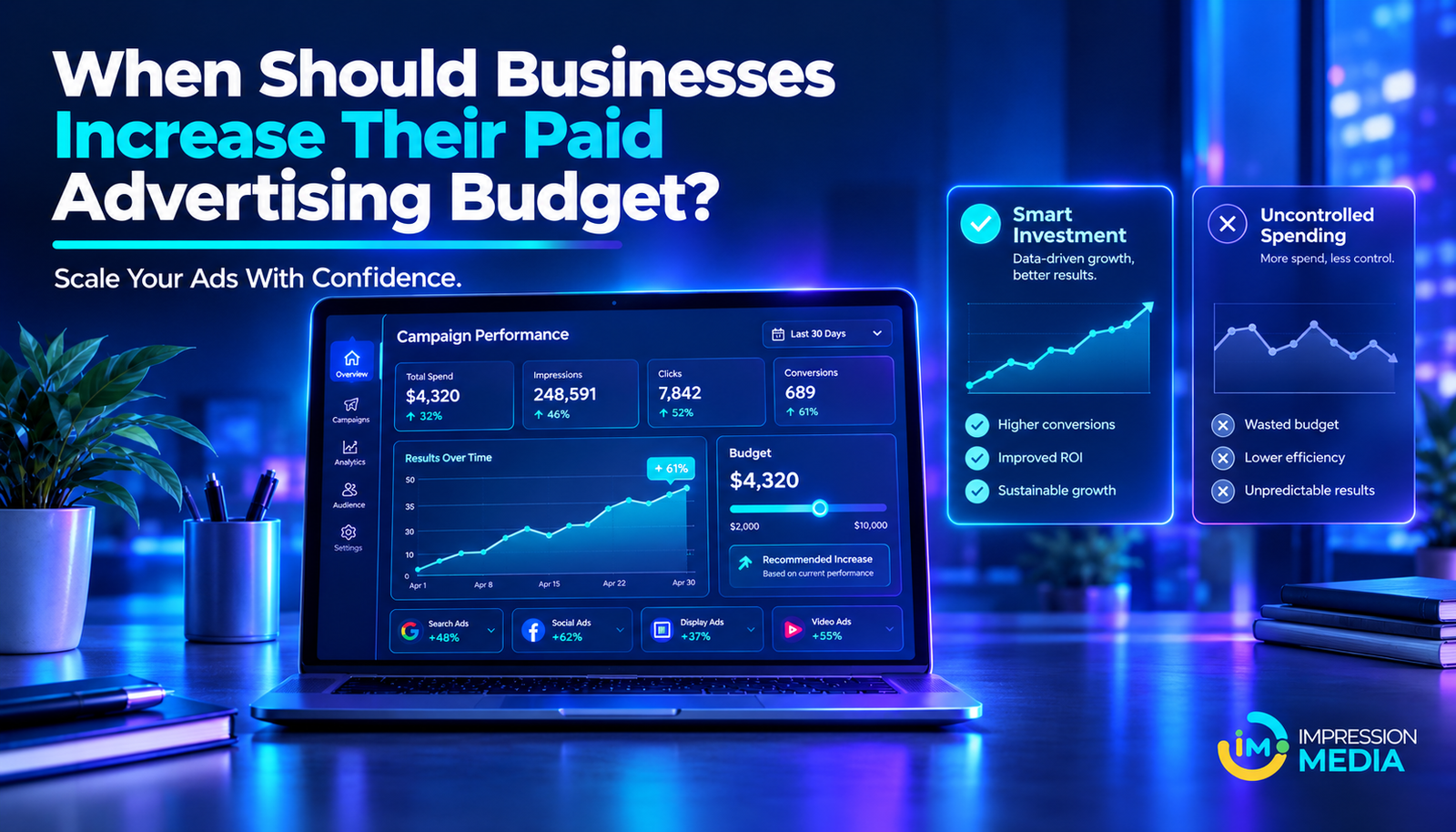
When Should Businesses Increase Their Paid Advertising Budget?
Increasing a paid advertising budget can help a business reach more potential customers, generate additional leads, and grow revenue. However, spending more on advertising does not automatically produce better results. If a campaign is struggling with poor conversions, weak targeting, or an ineffective landing page, a higher budget may simply increase the cost of those problems.
The key is knowing when a campaign is ready to scale. Businesses need to evaluate campaign performance, lead quality, customer acquisition costs, and their ability to convert additional demand into sales before committing more money.
Understanding when to increase your paid advertising budget helps you make informed decisions, reduce unnecessary spending, and build a more sustainable performance marketing strategy.
Why Timing Matters When Increasing an Advertising Budget
Paid advertising platforms can generate visibility and traffic relatively quickly, but profitable growth requires more than clicks and impressions. Businesses must understand how advertising spend translates into meaningful outcomes.
Increasing a budget too early can expose weaknesses in a campaign. On the other hand, keeping a successful campaign underfunded may limit opportunities to reach more customers.
The right time to increase advertising spend depends on campaign stability, business objectives, available resources, and the potential return from additional investment.
More Advertising Spend Does Not Always Mean More Sales
An increase in advertising spend may generate additional clicks, but those clicks do not necessarily lead to purchases or qualified enquiries.
For example, a business might double its advertising budget and attract twice as much website traffic. If its landing page is confusing or its offer does not meet customer expectations, conversions may remain unchanged.
Before increasing spending, businesses should identify what currently drives results and whether the campaign can handle additional investment without a significant decline in efficiency.
Scaling Too Late Can Limit Growth Opportunities
Businesses can also miss opportunities by being overly cautious with successful campaigns.
When advertising consistently generates qualified leads or profitable sales, a limited budget may prevent the business from reaching additional relevant customers. Competitors may capture some of that demand instead.
The goal is not to spend as little as possible. It is to invest enough to pursue valuable opportunities while maintaining acceptable acquisition costs and business profitability.
7 Signs Your Business Is Ready to Increase Its Paid Advertising Budget
Before scaling a campaign, evaluate whether the existing advertising setup is delivering reliable results. The following indicators can help businesses determine whether additional spending is justified.
1. Your Campaign Delivers Consistent Results
A campaign that performs well over a meaningful period provides a stronger foundation for scaling than one that has produced a few promising days.
Review performance across relevant time periods and account for factors such as seasonality, promotions, and changes in demand. Look for reasonably stable results rather than relying on a single spike in conversions.
Consistency does not guarantee future performance, but it gives you better evidence for making budget decisions.
2. Your Cost Per Acquisition Is Within Target
Cost per acquisition (CPA) measures how much a business spends to acquire a customer or another defined conversion.
For example, if a campaign spends ₹30,000 and generates 60 purchases, the average cost per purchase is ₹500.
Whether that result is profitable depends on the revenue and contribution margin associated with each purchase, along with other business costs.
If your CPA remains within your target and acquired customers generate sufficient value, increasing the budget may be worth testing.
3. Your Leads or Customers Are Worth Acquiring
A low cost per lead can appear attractive, but it does not tell the whole story.
If a campaign generates many enquiries that never become customers, increasing its budget may produce more work for the sales team without generating proportionate revenue.
Evaluate lead quality, sales conversion rates, average order value, customer lifetime value where appropriate, and the profitability of acquired customers.
When advertising produces commercially valuable outcomes, the case for scaling becomes stronger.
4. Your Campaign Has Reached a Meaningful Level of Data
Advertising decisions become more reliable when businesses have enough conversion data to understand how campaigns perform.
A new campaign with very few conversions may not provide enough evidence to justify a substantial budget increase. Results could change significantly as more data becomes available.
The amount of data required depends on the campaign, conversion cycle, sales volume, and variability in performance.
Rather than following a universal number of days or conversions, consider whether the available evidence is sufficient to support a confident decision.
5. Your Business Can Handle More Demand
Advertising can create demand, but businesses must be prepared to fulfil it.
An e-commerce company needs sufficient inventory and delivery capacity. A service provider needs enough staff to respond to enquiries and complete projects. A sales team needs a process for following up with new leads.
If additional demand creates delays, poor customer experiences, or missed opportunities, scaling advertising may hurt business performance.
Confirm that your operational capacity can support the growth you expect.
6. Your Landing Pages Convert Relevant Visitors
Paid advertising performance depends on what happens after someone clicks an advertisement.
A well-targeted campaign may still struggle if the landing page loads slowly, communicates an unclear offer, or makes the next step difficult.
Before increasing spending, review conversion rates, mobile usability, page relevance, calls to action, and the overall user experience.
Improving the existing landing page may help you generate more conversions from your current traffic before you invest in additional visitors.
7. You Have a Clear Plan for Measuring Results
Businesses should know how they will determine whether a budget increase has worked.
Set clear targets for metrics such as cost per acquisition, qualified leads, conversion rate, revenue, and return on ad spend. Make sure tracking is configured correctly and that conversions reflect meaningful business outcomes.
Without reliable measurement, it becomes difficult to distinguish genuine growth from temporary fluctuations or inaccurate reporting.
How Much Should You Increase Your Paid Advertising Budget?
There is no single budget increase that works for every business. The right amount depends on campaign stability, platform behaviour, available cash flow, and the level of risk the business can comfortably manage.
A gradual, measurable approach is generally more practical than making a large increase without a clear reason.
Increase Spending in Controlled Steps
Instead of making a dramatic change, test a manageable increase and monitor the results.
For example, a business spending ₹50,000 per month might test a new budget of ₹55,000, provided its current results and cash flow justify the change. This represents a 10% increase, not a guarantee that performance will remain unchanged.
The appropriate adjustment varies by platform and campaign structure. Some campaigns can accommodate budget changes more smoothly than others.
Monitor performance after each change and allow enough time to evaluate meaningful results before making another adjustment.
Set a Maximum Acceptable Acquisition Cost
Before scaling, establish the maximum cost your business can afford to acquire a customer while meeting its profitability goals.
This threshold should reflect more than advertising revenue. Consider product or service delivery costs, sales expenses, discounts, overheads, and the contribution margin generated by each customer.
For example, an online store selling a product for ₹3,000 cannot assume that a ₹2,500 acquisition cost is profitable simply because the purchase value exceeds the advertising cost.
A clear acquisition-cost target helps prevent growth from becoming expensive without improving business returns.
Reserve Budget for Testing and Experimentation
Not every additional advertising investment needs to go into an existing campaign.
Some budget can be allocated to testing new audiences, creative variations, landing pages, or advertising channels. These experiments may reveal better opportunities for future growth.
However, testing should have a defined purpose and a reasonable spending limit. Avoid spreading the budget across too many experiments without enough investment to evaluate them properly.
What to Check Before Scaling Different Advertising Channels
Different advertising platforms serve different purposes, so businesses should consider the characteristics of each channel before increasing its budget.
Google Ads and Search Advertising
Search advertising can capture people actively looking for a product or service. Before scaling, examine search terms, conversion quality, impression share, cost per conversion, and the relevance of landing pages.
If a campaign is already generating profitable conversions but has limited eligible traffic, additional budget may help capture more demand.
However, a larger budget cannot create unlimited search demand. Performance also depends on competition, keyword eligibility, bids, and audience intent.
Meta Ads and Social Media Advertising
Social media advertising can help businesses reach potential customers based on audience characteristics, interests, and platform signals.
Before increasing the budget, evaluate creative performance, conversion quality, audience saturation, and frequency where relevant. Review whether additional spend is reaching new potential customers or repeatedly showing advertisements to the same people.
Creative fatigue and changing audience behaviour can affect results, so scaling should be accompanied by ongoing creative testing.
Retargeting Campaigns
Retargeting focuses on people who have previously interacted with a business, such as website visitors or users who engaged with an advertisement.
These audiences can be valuable, but they are often smaller than prospecting audiences. Increasing the budget too aggressively may raise frequency without generating many additional conversions.
Review audience size, conversion volume, frequency, and incremental results before allocating more money to retargeting.
Warning Signs That You Should Not Increase Advertising Spend Yet
Sometimes the best decision is to improve the existing campaign rather than invest more money.
Consider postponing a budget increase when:
- Conversion tracking is incomplete or unreliable.
- Cost per acquisition is rising without a clear explanation.
- Lead volume is increasing but lead quality is declining.
- Landing pages have usability or technical problems.
- Advertising creatives are no longer attracting relevant engagement.
- The business cannot respond to additional leads or fulfil more orders.
- The campaign has too little reliable data to support a confident decision.
These warning signs do not always mean a campaign should be stopped. They indicate that the business should investigate the underlying problem before committing more budget.
How to Monitor Performance After Increasing Your Budget
A budget increase is not complete when the new amount is entered into an advertising platform. Businesses need to assess whether the additional spending is generating worthwhile incremental results.
Compare Results Against a Baseline
Record important campaign metrics before making a change. After increasing the budget, compare results against that baseline while accounting for seasonality, promotions, and other changes that could influence performance.
Monitor total conversions as well as efficiency metrics. A campaign may generate more sales while its cost per acquisition increases, so businesses need to decide whether the additional volume remains profitable.
Evaluate Incremental Results
The key question is whether the extra advertising spend generated additional valuable outcomes.
For example, if increasing a budget by ₹10,000 produces additional qualified leads at an acceptable cost, the experiment may be successful. If spending rises but conversions remain flat, the business should investigate whether the additional budget is reaching the right audience or whether the campaign needs further optimisation.
This approach helps businesses assess the value of the additional investment rather than judging success by total results alone.
Avoid Reacting to Every Short-Term Fluctuation
Advertising performance can change from day to day. Making repeated budget adjustments in response to minor fluctuations can make it harder to understand what is driving results.
Set a review schedule that reflects your conversion cycle and campaign volume. Investigate meaningful changes, but avoid drawing conclusions from insufficient data.
The objective is to make decisions based on evidence rather than short-term reactions.
Conclusion
Businesses should increase their paid advertising budget when there is credible evidence that additional spending can generate valuable results. Consistent campaign performance, acceptable acquisition costs, qualified leads, reliable tracking, and sufficient operational capacity all contribute to that decision.
Before scaling, identify weaknesses in targeting, creative assets, landing pages, and conversion measurement. Then increase spending in a controlled way, monitor the additional results, and adjust your approach based on actual business outcomes.
At Impression Media, a performance-focused advertising strategy should connect budget decisions with meaningful goals such as qualified leads, customer acquisition, and profitable growth. The objective is not simply to spend more on ads. It is to make every additional investment serve a clear business purpose.
The right time to scale is when your campaign has earned the investment through measurable results—not simply when you want more traffic.